The LinkedIn Paradox is the reason why I am forced to publish this text here instead of on LinkedIn as originally planned.
Anyone who regularly spends time on LinkedIn is surely familiar with the phenomenon: everyone spreading wisdom. Self-presentation is everywhere. It’s either direct and blunt posts about one’s own accomplishments or texts on any given topic adorned with a polished image of the person.
As social beings, we tend to pay the most attention to other people, making these images effective clickbait. When we see a picture of another person, we want to know “what’s the story behind it.” The people in the pictures are often attractive and naturally portrayed, albeit unintentionally.
I can imagine that hours of preparation are required for a photo so that the hair looks as if it were supposedly captured in that exact moment.
But back to the topic:
Since LinkedIn is a platform for self-promotion, wisdom must naturally evolve to higher levels that surpass the previous (lower) levels. In this example, it becomes clear towards the end what I mean by the LinkedIn Paradox:
Level 1: I have a job.
Level 2: I have a top job.
Level 3: You have to work hard for a top job (like me).
Level 4: It requires not only hard work but also finesse (look at me).
Level 5: I don’t even want a (toxic) top job; I’m a down-to-earth, honest worker (and therefore superior).
Level 6: It’s not about jobs, it’s about the person (me). I rise above and am not a victim of the (toxic) performance society.
Level 7: In being myself, I am the best. I embrace my flaws (unlike you).
Level 8: I am myself and still can have a top job.
Level 9: I am myself, and THEREFORE I can have a top job.
Level 10: It doesn’t matter who I am or what job I have (I am wise).
Level 11: Writing about oneself is toxic (I don’t do it; I am wiser).
Level 12: Writing on LinkedIn is a sign of (toxic) self-importance (instead, follow me).
Level 13: I make fun of all (toxic) people on LinkedIn (but don’t forget to like).
And so on.
First and foremost, the trend of “toxicity” has recently emerged (I used it here). Anything labeled as “toxic” is considered absolutely bad and requires no further explanation. “Toxic” is the beginning and end of any argument chain at all levels. But how toxic is toxicity?
In the above example with the levels, it already becomes clear what I’m getting at: No matter what you read, you can never be sure if the author is secretly just self-promoting on LinkedIn. And on the other hand, no matter what you write, you can never be sure if the readers perceive the message authentically and without self-promotion.
The crucial point is not the presence or absence of the author’s conscious intention to self-present but to what extent they can trust themselves that the message was not secretly written by them to collect likes. The dynamics of “outperforming” may automatically and unconsciously occur without one noticing or admitting it.
However, what is really annoying in the daily life of LinkedIn is the impression that the author doesn’t care at all if they are exposed. The desire to collect likes is much stronger than the shame of contradicting one’s own post in some way.
Here’s an example (there are countless ones):
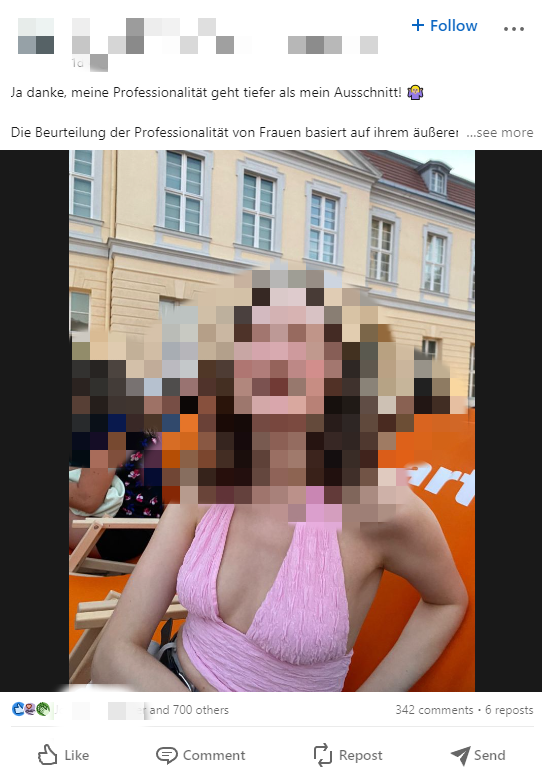
In the above image, a woman writes that women can dress however they want, regardless of the context, whether it’s in leisure or professional settings. As an example, she also posts a more revealing picture of herself. The message itself is entirely justified. However, through her image, this post receives the attention that she rejects in its negative version. The post has more than ten times the number of likes compared to her other posts. She doesn’t want to be judged by her appearance, yet she leverages the undeniable power of her looks and capitalizes on the positive evaluation. From the sober perspective of the LinkedIn Paradox, the question of intention doesn’t even arise; it’s part of everyday life on LinkedIn.
Here’s another example:
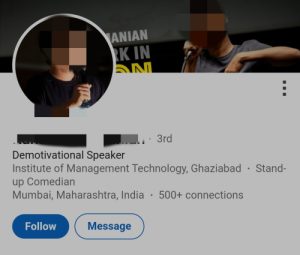
Here, we see a person who often mocks LinkedIn culture. The description even shows the label “Demotivational Speaker.”
But the same applies here: This is and remains a LinkedIn profile that is curated and aimed at collecting likes.
That is precisely the LinkedIn Paradox: One cannot write anything objectively and as a complete observer on the subject of self-presentation or general LinkedIn posts as long as one is doing it on LinkedIn itself.
I considered publishing this text on LinkedIn in the same way, highlighting the impossibility of escaping the paradox and thus absolving myself of guilt. However, precisely this mention of the impossibility and the attempt to be innocent could be the greatest and ultimate deception towards oneself and the readers since this post ultimately exists on LinkedIn and receives likes.
The LinkedIn Paradox can also be observed on other platforms such as Facebook, Instagram, dating platforms, etc.
There is even a trend: “Luddites,” i.e., “technology refusers,” are mostly young people who consciously do not use smartphones. The irony is that these “Luddites” occasionally post photos of themselves with the help of others. Even if this happens only once a year, this one appearance on social media, in society, gives a completely different meaning and feeling to their phoneless life than if they were actually living without a phone, unnoticed by anyone.
LinkedIn as a Societal Macrocosm
The LinkedIn network doesn’t include family and friends but professional connections. LinkedIn feels like communication with society as a whole to the individual.
If one wants to communicate with society, they use LinkedIn. And the desire for communication with society often arises when contemplating conventions or feeling the internal pressure to conform to them.
To appear before the “royal court of society,” one prepares ritually: they dress fashionably, use fashionable terms, and employ fashionable language to ultimately secure their own “prayer to society” with all safety measures, ensuring that everyone supports and shares it, so that it truly reaches the center of society in a positive way.
If you spend a long time on LinkedIn, it becomes difficult to remove the LinkedIn lens. Everything is viewed from a societal perspective, and shareable insights accumulate in the mind almost effortlessly. For these reasons, LinkedIn is, in a way, also art because it allows one to view the world from a different perspective. The “Luddites” view their phoneless life from the perspective of a version of themselves without a phone in contrast to a highly connected version of themselves. The one post a year by a Luddite is necessary to maintain the sense of superiority created by the contrast.